
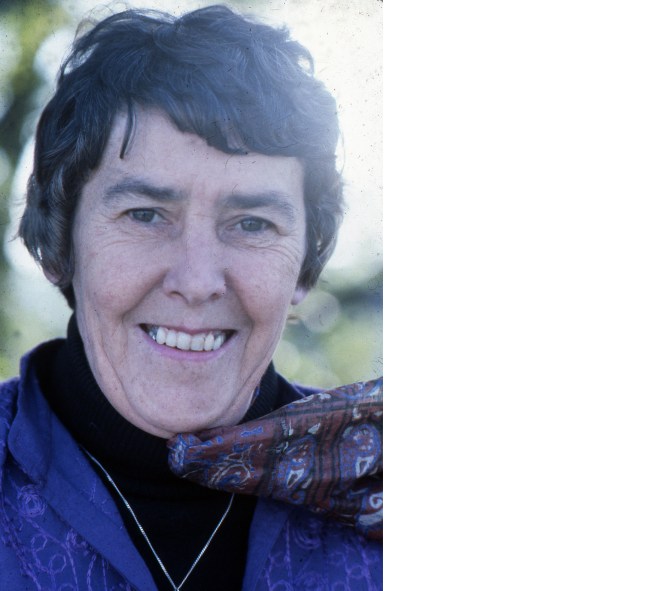
Norah Golden was an early arrival in the Ballydehob Artists community, partnering ceramicist Christa Reichel, who is usually acknowledged as ‘first on the scene’ in Ballydehob, although there had been an artists’ community in Baltimore, started in 1955. Reichel and Golden established the Gurteenakilla Pottery, not far from the village, where they designed and made a range of domestic ware, raw glazed with tin and decorated using cobalt, copper and iron oxides.
Norah was also a painter and skilled in making batik wall hangings: the Museum is fortunate to have some good examples of her work in the permanent collection.
In 1968 Reichel and Golden formed Ballydehob Artists Ltd and opened The Flower House, comprising a shop, gallery and studios. The distinctive painted facade of this building on Ballydehob’s main street became a focus for artists and craftspeople drawn from across Europe, and became central to the creative community that is now celebrated by BAM.
In 1995 Norah moved to England to stay with friends as was becoming ill with lung cancer and could no longer manage alone. Her legacy lives on in Ballydehob.
“I regard Norah the real force behind the flowering of the Ballydehob art community over 30 years. She made quite a career out of farm animal portraits for the local farmers in the tradition of 19th century painters. Patrick Skene Catling wrote most eloquently about her 1994 Pigs exhibition, and there was a full article in the Mail on Sunday Magazine, of which I have a copy. Norah’s portrait of Daisy, one of Tom Ferguson’s prize porkers, hangs in the Levis bar where much of Norah’s work was sold informally by Nell and Julia.” – Sarah Webb, friend

 Ballydehob Arts Museum